

Quick answer: what is a test IBAN?
A test IBAN is a synthetic International Bank Account Number created to exercise software behavior. Teams use it for payment-form fields, country selectors, input normalization, API fixtures, automated browser tests, screenshots, training, and documentation. The value should look like the selected country's format and may pass the mathematical checksum rules that your code needs to handle.
The important word is test. A generated string is not a shortcut to a real account, a beneficiary, or a bank directory. On this site, the Bulk IBAN Generator creates isolated synthetic rows, while the IBAN Checker inspects the characters you provide. Neither tool contacts a bank or verifies ownership.
- Good use: form validation, parsers, QA fixtures, regression tests, demos, and technical writing.
- Not a good use: transfers, direct debits, beneficiary creation, ownership claims, or account discovery.
- Keep the fixture label, environment boundary, and cleanup rule next to the test data.
Synthetic test data is not a real bank account
A synthetic value is designed to exercise a format. It can contain the right country prefix, the expected total length, plausible BBAN character classes, and a MOD-97 remainder of 1. Those checks answer a narrow engineering question: does this string behave like a structurally valid IBAN for the selected rule?
A bank-issued IBAN answers different questions. It may be connected to a customer account, a bank and branch, a currency, a payment rail, a beneficiary, and current account status. A local checker cannot establish those facts from the characters alone. This distinction is why a value can be checksum-valid and still be unassigned, inactive, unsuitable for a payment, or deliberately reserved as a test fixture.
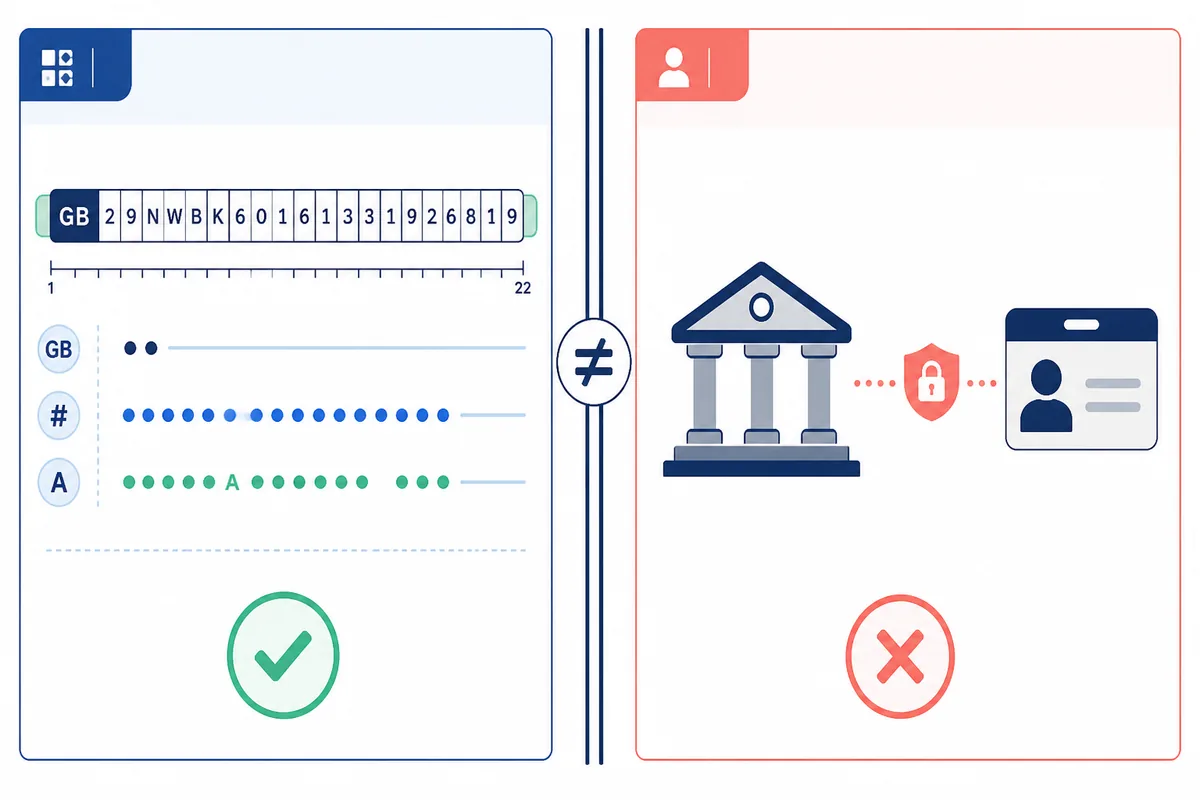
| Question | A test IBAN can help with | It cannot prove |
|---|---|---|
| Does the input fit the country rule? | Country prefix, fixed length, and broad character pattern. | That a bank issued the number. |
| Does the checksum calculation pass? | MOD-97 behavior and error-message paths. | That an account exists or can receive money. |
| Does the form store the value correctly? | Spaces, lowercase input, copy/paste, API serialization, and database limits. | That the named beneficiary owns it. |
| Does a payment succeed? | Only a simulated or provider sandbox flow, when the provider supports one. | Production reachability, ownership, sanctions status, or settlement. |
Validate a test IBAN in three layers
A useful QA fixture is not just a random string. Start with the selected country's registered format, then test the layers independently so a failure points to the right code path. The IBAN Countries directory helps compare supported lengths and broad BBAN patterns; the IBAN Decoder shows visible country, check-digit, and BBAN portions for a complete value.
First, check the country code and total length. Second, check the allowed numeric, alphabetic, or alphanumeric characters for the BBAN. Third, run the international MOD-97-10 calculation. A test suite should include both passing and intentionally failing values, because error handling is part of the contract.
- 1. Country and lengthSelect a supported country and confirm that the complete value has the registered fixed length.
- 2. Character patternCheck whether each national field accepts the digits or letters required by that country rule.
- 3. MOD-97 checksumMove the country and check digits according to the algorithm and confirm the expected remainder.
- 4. Business boundaryRecord that the result is structurally valid only; do not turn it into an ownership or payment claim.
- For a length failure, keep the checksum failure separate so the UI explains the first useful problem.
- For a checksum failure, change one check digit in an otherwise valid fixture to test a precise error state.
- For a country-pattern failure, use a letter in a numeric field or a digit in an alphabetic field only when the test case is intentional.
A safe QA fixture workflow
Treat a test IBAN like any other synthetic fixture: define its purpose, generate it from a known rule, validate it, label it, and keep it inside the environment that needs it. The sequence matters because a mathematically valid string can still become dangerous if it is copied into a production seed, customer export, invoice template, or real beneficiary list.
For small cases, create a single value with the homepage generator. For a matrix or regression suite, use the bulk tool to export CSV or JSON, then add explicit metadata in your own fixture file: country, expected length, expected result, test purpose, and cleanup owner. The site generates values in the browser; your repository and CI pipeline still need their own secret and production-data controls.
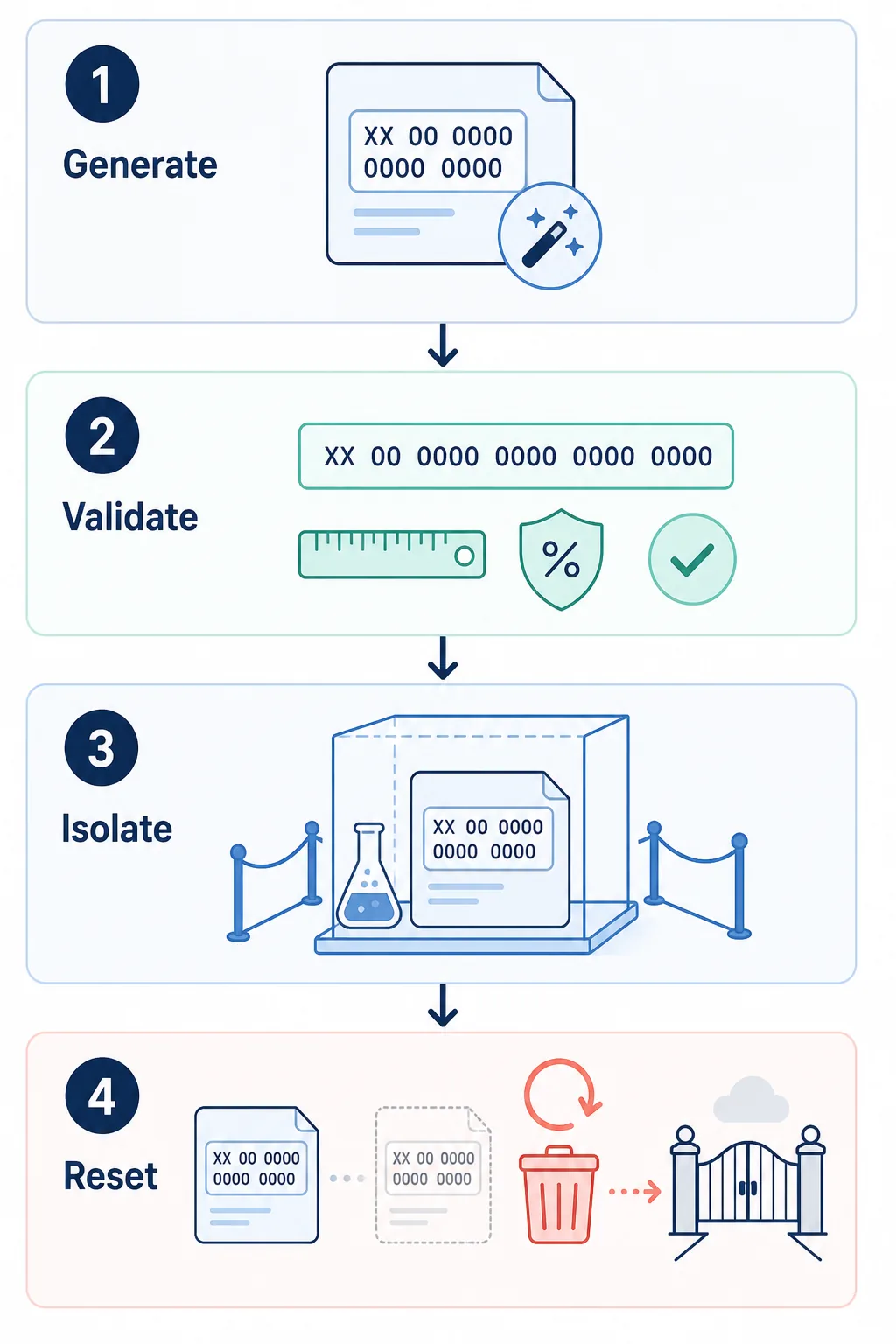
- DefineWrite down the country, field behavior, expected outcome, and why the fixture is needed.
- GenerateCreate synthetic values with a country rule; never copy customer account details into a test database.
- ValidateRun length, character-pattern, and MOD-97 assertions and store the expected result.
- Isolate and cleanKeep fixtures in test-only datasets, block production promotion, and delete or rotate them after the run.
Build an IBAN test matrix instead of one happy path
One passing value proves very little. A robust suite covers country differences, presentation differences, and predictable failures. Include at least one short supported format and one longer format, a numeric BBAN, an alphanumeric BBAN, a printed value with spaces, a compact electronic value, lowercase input, and a value with a changed check digit.
The exact countries depend on your product. The table below is a planning pattern rather than a claim that every value can be used in a provider's production sandbox. If a payment provider supplies its own sandbox identifiers, follow that provider's documentation and keep those values separate from generic format fixtures.
- Store expected outcomes with the fixture so a future validator change is reviewable.
- Use descriptive IDs such as `iban-de-length-22-valid` rather than an unlabeled random string.
- Do not include a real person's name, card number, invoice, or bank statement in a synthetic test case.
| Case | What to assert | Expected result |
|---|---|---|
| Short country format | Length and country-specific BBAN layout. | Accepted when the rule and checksum match. |
| Long country format | Maximum field width and database/API serialization. | Accepted without truncation or hidden whitespace. |
| Print-form input | Spaces every four characters and copy/paste normalization. | Normalized before validation; original display can be restored. |
| Lowercase input | Case normalization for alphabetic fields. | Either normalized safely or rejected with a clear message. |
| One check digit changed | Checksum error path and user feedback. | Rejected as mathematically inconsistent. |
| One character short or long | Length error precedence and boundary behavior. | Rejected before a misleading success state. |
| Fixture in production seed | CI guard or environment marker. | Blocked, quarantined, or failed before deployment. |
Common mistakes and practical limits
The most common mistake is using the phrase fake IBAN as if it meant a safe payment value. In search results, fake may mean a synthetic development fixture, but the label is ambiguous and can also suggest deception. Prefer test IBAN, synthetic IBAN, or fixture in code, documentation, and team communication. If a user asks for a real transfer value, send them to their bank-issued source instead of a public sample.
Another mistake is treating a checker as a bank lookup. A browser tool can explain the characters it sees, but it does not know whether a bank identifier is active, whether an account belongs to a person, whether a beneficiary passed screening, or whether a payment will settle. For those questions, use the appropriate bank, payment provider, or regulated verification process.
- Do not call a synthetic value official, safe for payment, assigned, or ownership-verified.
- Do not infer an IBAN from a name, card number, local account number, or screenshot.
- Do not publish a fixture in a customer-facing invoice, refund instruction, payroll file, or direct-debit mandate.
- Do not rely on a universal reserved range; keep generated data isolated and clearly labeled.
Test IBAN FAQ
What is a test IBAN?
A test IBAN is a synthetic value used to exercise payment-form behavior, parsers, validation messages, fixtures, browser flows, or documentation. It is not a bank-issued account detail.
Is an IBAN test number the same as a real IBAN?
No. It can follow a registered country format and pass MOD-97 while still being unassigned or unsuitable for a payment. Treat it as test data only.
Does a checksum-valid IBAN mean the account exists?
No. The checksum is a mathematical consistency check. It does not prove bank assignment, account status, beneficiary identity, ownership, sanctions status, or payment reachability.
Can I use a test IBAN in production?
No. Keep it in development, QA, staging, demos, documentation, or training. Add environment guards so synthetic fixtures cannot enter real payment flows.
Should I search for a fake IBAN generator?
For software testing, use the safer terms test IBAN, synthetic IBAN, or IBAN fixture. A public generator is not a source of real banking details and must not be used to deceive or make a payment.
What should a QA test matrix include?
Include multiple country lengths and BBAN patterns, print and electronic formats, lowercase input, a changed check digit, too-short and too-long values, normalization, and a guard that blocks fixtures from production data.
Bottom line
Test IBAN numbers are useful because they let teams exercise country-specific payment fields without copying customer banking data into development. The safe pattern is simple: generate a synthetic value, validate the expected structure and checksum, record the intended test outcome, and keep the fixture isolated.
A valid-looking string is still only a string. Use the site's generator, checker, calculator, decoder, and country pages for their narrow development jobs, and obtain real payment details from an authoritative bank or provider when a real transaction is involved.
Standards and testing references
- Swift IBAN Registry — The current registered country formats and IBAN registration context.
- PayPal IBAN Generator — A first-party example of provider-side IBAN generation for sandbox and testing contexts.
- Rapyd IBAN numbers for testing — Provider documentation showing why sandbox test values should follow the provider's own rules.
- IBAN test numbers — A third-party testing reference; use its examples only as test data, not as real account information.