

Where can you find your IBAN number?
You can usually find your IBAN on a recent bank statement, in the account-details area of online banking, or inside your bank’s mobile app. If it is missing, ask the bank through an authenticated channel instead of trying to reconstruct it.
Confirm the correct account, currency, and account-holder name before copying. Look for labels such as account details, receive money, international payments, or local account information.
Do not infer an IBAN from a name, card number, or local account number. A checker can inspect a supplied value, but only the bank or account provider can supply the authoritative account details.
Quick answer: where to look first
Your IBAN is usually printed in the account details section of a bank statement, shown beside your account information in online banking, or displayed in your bank's mobile app. Some banks also print it on a debit-account confirmation, a direct-debit mandate, or a document used to receive salary or international payments. Look for the label IBAN, not only for a local account number.
If you are asking how to find your IBAN number for a specific payment, use the value supplied by your bank or recipient account provider. Do not guess the country prefix, add zeros, or copy a number from an unrelated example. A mathematically well-formed IBAN can still belong to nobody, belong to a different account, or fail a bank's own checks.
- Paper statement: check the account summary or payment-details block.
- Online banking: open the exact account and choose account details, account information, or receive-money instructions.
- Mobile app: look for account details, local account information, or international transfer settings.
- Bank support: ask through an authenticated channel if the number is not visible.
Four places to find an IBAN
The wording differs between banks, but the locations are similar. A current statement is often the fastest option because it connects the value to a named account and an issue date. In online banking, avoid searching only for the word transfer: the IBAN may sit under account details, profile, beneficiary information, or a page for receiving money. If you see several accounts, confirm the account name and currency before copying anything.
When a bank hides the full number until you authenticate again, that is a security control rather than a missing IBAN. Use the bank's normal sign-in flow and do not paste your password, one-time code, or full banking credentials into a third-party form. If the bank offers a copy button, compare the copied electronic value with the on-screen value before sending it.
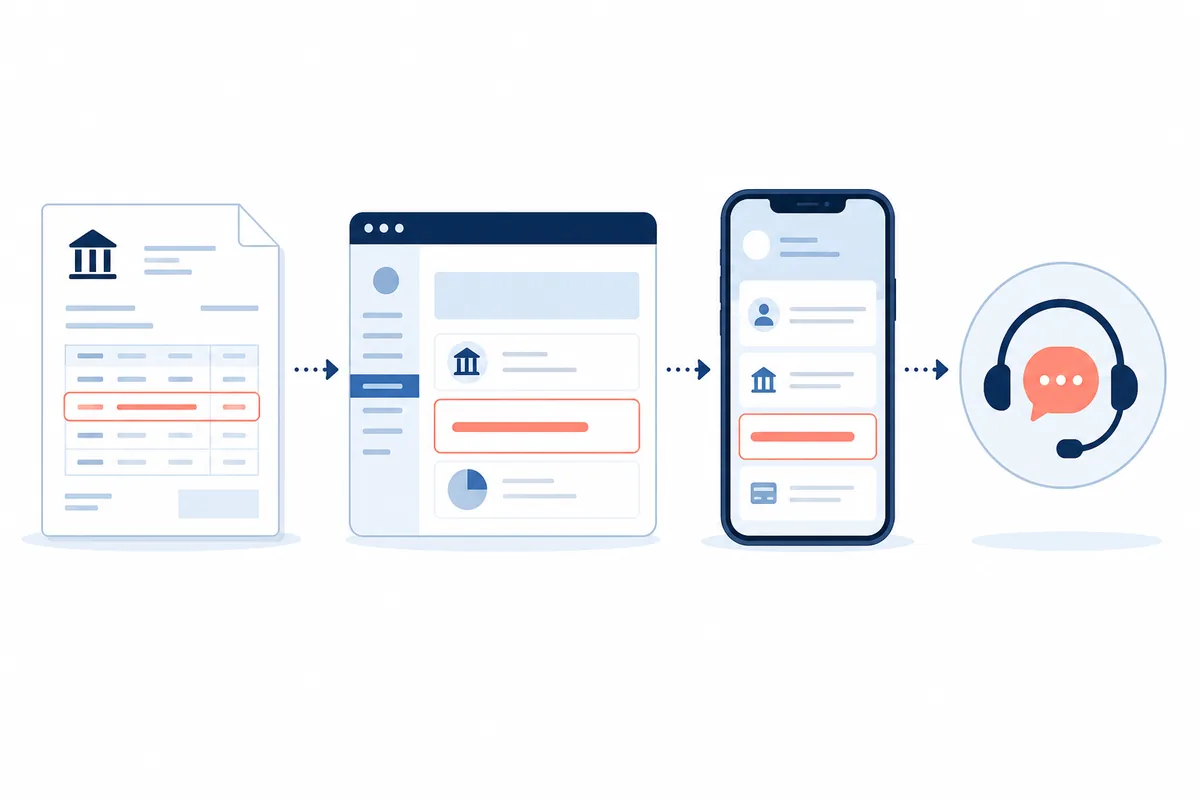
- Confirm the accountCheck the account holder name, account nickname, currency, and last digits before copying.
- Open the details viewLook for account details, receive-money instructions, international payments, or a similar label.
- Copy the electronic valueUse the bank's copy action when available, then compare the first and last characters.
- Share only what is neededSend the IBAN through the intended secure channel and never include passwords or one-time codes.
What an IBAN number looks like
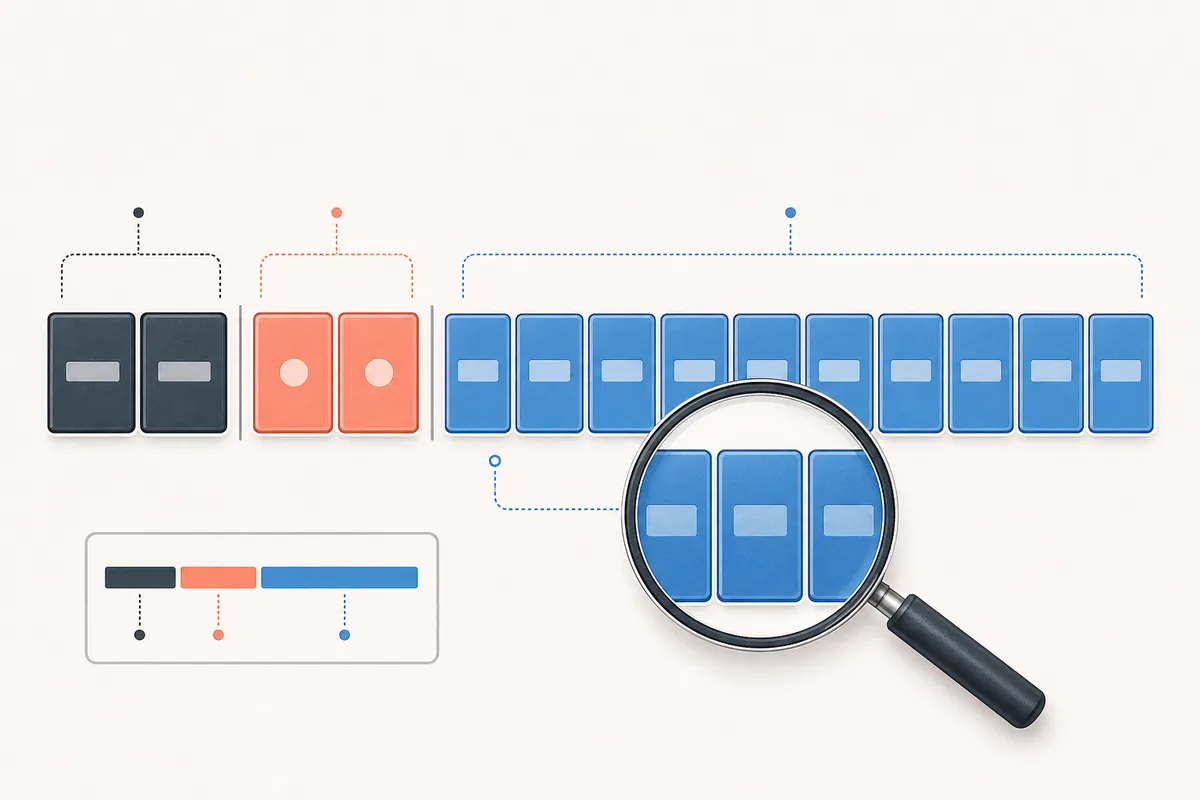
An IBAN is a country-specific international account identifier. At a high level, it begins with a two-letter country code, followed by two international check digits, and then a Basic Bank Account Number, usually called a BBAN. The BBAN holds the national bank, branch, account, and domestic check fields defined for that country. The total length and character pattern are not identical everywhere.
Printed IBANs commonly group characters with spaces to make reading easier. Electronic forms normally remove those spaces. Lowercase letters are often normalized to uppercase, but you should follow the receiving bank's instructions. The table below explains the visible parts without pretending that every country uses the same internal fields.
| Part | What it means | What to do |
|---|---|---|
| Country code | Two letters identifying the country format. | Confirm it matches the bank or account country. |
| International check digits | Two digits used by the MOD-97 checksum. | Copy them exactly; do not recalculate from a partial number. |
| BBAN | The national bank-account structure after the first four characters. | Use the bank's complete value; an account number alone may be incomplete. |
| Print spacing | Visual grouping used on paper or screens. | Remove spaces only when an electronic field requires it. |
Why the IBAN format changes by country
An IBAN is not a universal account-number template. Each participating country has a registered structure and length, and the BBAN can combine different bank, branch, account, and domestic-check fields. A German IBAN, a French IBAN, and a UK IBAN therefore do not have the same number of characters or the same visible field boundaries. Use the country attached to the account, not the country where you currently live.
This is also why a website cannot safely tell you an individual's IBAN from a name or a local account number alone. A country format can explain what a supplied string appears to contain, but it cannot prove that a bank issued it or that it belongs to a person. For a country-level reference, compare the supported lengths and broad patterns in the IBAN Countries directory.
- Do not convert a local account number into an IBAN by adding a country code and guessed check digits.
- Do not assume the same bank uses the same BBAN layout in every country.
- Do not treat a country's standard length as proof that a particular account exists.
How to copy and check an IBAN safely
When you have found the number, compare it with the recipient's bank-issued details before using it. Check the country prefix, the first and last characters, the account name, and the purpose of the payment. If you received the value by email or chat, confirm it through a trusted second channel when the payment is important. Fraudsters can replace payment instructions even when the IBAN format itself looks correct.
A format checker can catch missing characters, unsupported country codes, broad pattern errors, and MOD-97 checksum failures. It cannot confirm bank ownership, account status, beneficiary identity, sanctions status, or payment reachability. If you already have a complete string, the site's IBAN Checker can inspect it locally, while the IBAN Decoder can show the country code, check digits, BBAN, and reviewed national fields.
- Normalize presentationRemove display spaces only for the electronic field and keep a copy of the original bank-issued presentation.
- Run a format checkUse a checker to find structural or checksum problems, not to establish ownership.
- Confirm the beneficiaryCompare the name and payment purpose through the bank or recipient's trusted channel.
- Keep sensitive data controlledDo not place full IBANs, credentials, or one-time codes in screenshots, public tickets, or analytics logs.
IBAN vs SWIFT/BIC: which one do you need?
IBAN and SWIFT/BIC are related but different identifiers. An IBAN identifies a particular account under a country's IBAN format. A SWIFT/BIC identifies a bank or financial institution for routing messages and payment instructions. A transfer may ask for one, the other, or both depending on the country, currency, payment rail, and bank's form.
If a form asks for an IBAN, do not replace it with a SWIFT/BIC code. If it asks for a BIC, do not paste the account's IBAN into that field. The receiving bank or payment provider should tell you which fields are required. The comparison below is a quick orientation, not a substitute for the instructions on the actual payment.
| Identifier | Usually identifies | Typical use |
|---|---|---|
| IBAN | A specific bank account in a participating country. | Account details for receiving or sending an international payment. |
| SWIFT/BIC | A bank or financial institution and sometimes a branch. | Routing information requested by a bank or payment network. |
| Local account number | A domestic account under local banking rules. | Domestic payments or part of a national BBAN. |
| Routing or sort code | A domestic bank or branch route. | Country-specific domestic payment instructions. |
Common mistakes when looking up an IBAN
The most common mistake is confusing an IBAN with the local account number. Another is copying an old statement after the account has changed, or selecting the wrong currency account in a multi-account banking app. People also paste a print-formatted value with spaces into a field that expects electronic format, or remove a character while copying from a PDF. A checker can identify many of these errors, but it cannot know which account you intended.
Avoid using random online IBAN examples as a substitute for your own details. Examples are useful for software testing and learning the structure, but they are not payment instructions. If you need synthetic data for a form or test suite, use the site's IBAN Calculator or generator tools and keep the output isolated from real payment workflows.
- Wrong account or currency selected in online banking.
- Old statement or outdated beneficiary record used without confirmation.
- Country code, check digits, or one BBAN character omitted during copying.
- Print spaces or punctuation pasted into an electronic-only field.
- A synthetic example mistaken for a bank-issued account.
If you still cannot find your IBAN
Contact the bank through an authenticated app message, secure mailbox, branch, or the phone number printed on an official card or statement. Explain which account and country you need, and ask the bank to confirm whether the account supports IBAN transfers. A bank may display the value only after identity verification or may provide it in a downloadable account-details document.
If someone else is sending money to you, ask them to use the exact account details supplied by your bank. Do not ask a third-party website to infer your IBAN from a name, card number, or partial account number. When the issue is a payment form rather than the account itself, ask the recipient bank which fields are mandatory and whether the form expects print or electronic format.
How to Find an IBAN FAQ
Where do I find my IBAN number?
Check a recent bank statement, the account-details page in online banking, or the account information section of your bank's mobile app. If it is not shown, ask the bank through an authenticated channel.
Is an IBAN the same as an account number?
No. An IBAN contains a country code, two international check digits, and a country-specific BBAN. A local account number is only one possible part of that national structure.
Can I find an IBAN from a name or card number?
You should not rely on a third-party lookup based on a name or card number. Obtain the value from the bank or the account holder through a trusted channel.
Is an IBAN the same as a SWIFT or BIC code?
No. An IBAN identifies a specific account, while a SWIFT/BIC identifies a bank or financial institution for routing. A payment may require one or both.
Does a valid IBAN prove that an account exists?
No. A format and MOD-97 check can show mathematical consistency, but it does not confirm bank assignment, account existence, ownership, status, or payment success.
Can I find an IBAN from an account number?
Not reliably. A local account number may be only one part of a country-specific BBAN. Get the complete IBAN from the bank statement, authenticated account view, or account holder.
What should I do if my IBAN is missing?
Open the bank’s secure message or support channel, visit a branch, or call the official number on a statement or card. Specify the exact account and country you need.
Bottom line
The reliable way to find your IBAN number is to retrieve it from the correct bank statement, authenticated online-banking account, mobile app, or bank support channel. Use the country format and a local checker to catch copying errors, but keep the distinction clear: format validity is not proof of ownership or payment reachability.
For a complete IBAN you already have, use the Checker or Decoder. For test data, use synthetic generator tools rather than copying a customer's banking details.
Official format references
- Swift IBAN Registry — Current country-level IBAN format and registry reference.
- ISO 13616-1 — International standard describing the elements of an IBAN.