
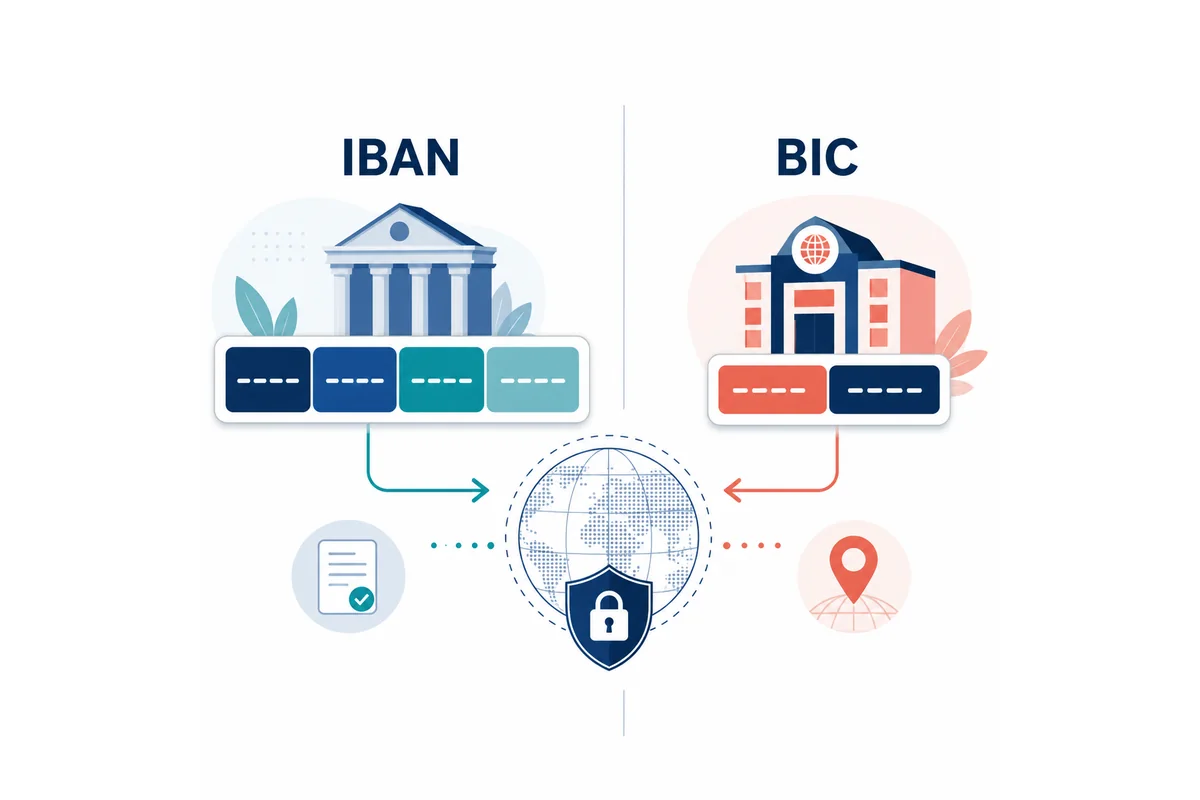
IBAN vs SWIFT: what is the difference?
IBAN identifies a particular bank account, while SWIFT/BIC identifies the bank or financial institution used in payment routing. A transfer may require the IBAN, the SWIFT/BIC code, or both, depending on the banks, country, currency, and payment rail.
Do not replace one identifier with the other. Use the exact values supplied by the receiving bank or payment provider, and treat a format check as a character check rather than proof that an account exists.
If a form asks for both, match the account and institution details to the same beneficiary and payment route before submitting the transfer.
What an IBAN identifies
An International Bank Account Number, or IBAN, identifies a particular account under a participating country's registered format. It normally starts with a two-letter country code and two international check digits, followed by the country's Basic Bank Account Number (BBAN). The BBAN can contain bank, branch, account, and domestic-check fields, so its length and character pattern vary by country.
An IBAN is therefore account-level information. It is the value a bank or account provider gives you when another party needs the details for a transfer, payroll instruction, direct debit, or account setup. Print spacing may make the value easier to read, but an electronic form usually expects the same characters without spaces.
A format checker can review country support, length, broad character rules, and the MOD-97 checksum. That is useful for catching a copied character or an incorrectly formatted test value, but it does not prove that a bank issued the IBAN, that an account exists, or that a beneficiary owns it.
| IBAN part | What it tells you | What it does not prove |
|---|---|---|
| Country code | Which registered country format applies. | Where the account holder currently lives. |
| Check digits | Whether the characters can pass the international checksum. | That the account is open or assigned. |
| BBAN | The national bank-account structure after the first four characters. | That every bank or branch field is active. |
What a SWIFT/BIC code identifies
A SWIFT code is commonly used to mean a BIC, or Business Identifier Code. It identifies a bank or other financial institution in payment instructions and financial messaging. Depending on the code, the characters can identify an institution, country, location, and an optional branch or department. A BIC is usually eight or eleven characters long, which makes it visibly different from a country-specific IBAN.
SWIFT/BIC is institution-level information, not an account number. Two customers at the same bank can use the same BIC while having different IBANs. Conversely, an account's IBAN should not be pasted into a form field labelled BIC, SWIFT, bank identifier, or institution code.
Banks and payment providers may still apply different rules to the same payment rail. Some transfers identify the receiving institution from the IBAN and do not require a separate BIC; others ask for a BIC because of the route, currency, bank form, or correspondent-bank arrangement.
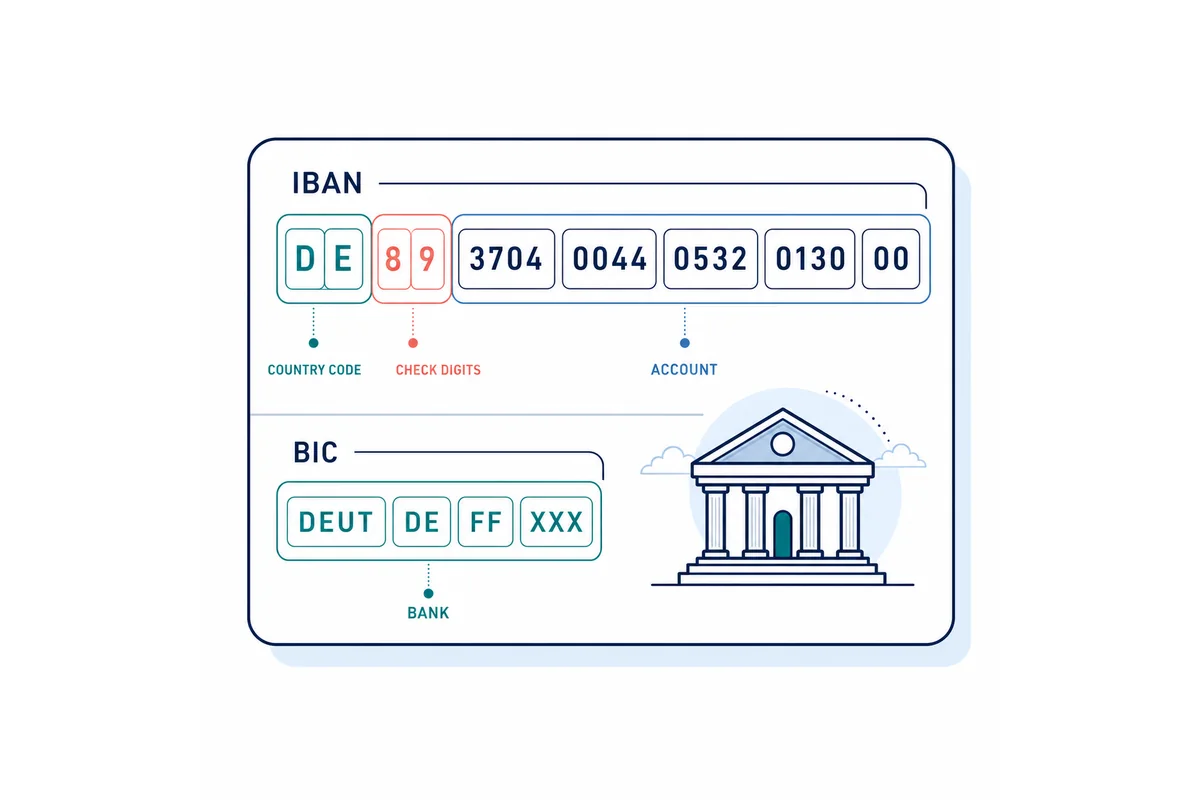
- IBAN: a particular account under a country's format.
- SWIFT/BIC: a bank or financial institution used in routing instructions.
- Local account number: a domestic account field that may be only one part of an IBAN.
- Routing or sort code: a country-specific domestic route that is not automatically a BIC.
IBAN vs SWIFT/BIC: side-by-side comparison
The simplest way to remember the difference is account versus institution. IBAN answers, “Which account should receive the funds?” SWIFT/BIC answers, “Which institution should be used in the payment route?” A bank form may ask for either one or both, so read the field labels rather than guessing from the payment's country.
The table below is a practical orientation. It is not a universal payment rule: the sender's bank, the recipient's bank, and the payment provider can require additional information such as the beneficiary name, local clearing code, address, currency, or purpose of payment.
| Identifier | Usually identifies | Typical use | Format clue |
|---|---|---|---|
| IBAN | A specific bank account. | International account details and beneficiary instructions. | Country code + check digits + country-specific BBAN. |
| SWIFT/BIC | A bank or financial institution. | Institution routing and financial messaging. | Usually 8 or 11 letters and digits. |
| Local account number | A domestic account under local rules. | Domestic payments or a component of a BBAN. | Length and meaning depend on the country and bank. |
| Sort/routing code | A domestic bank or clearing route. | Country-specific local payment systems. | Do not assume it is a BIC or part of every IBAN. |
When you may need both IBAN and SWIFT/BIC
You may see both fields on an international transfer form when the payment provider wants an account identifier and a separate institution route. This is especially common when a bank's workflow, currency, correspondent bank, or destination country uses an additional BIC field. A form that asks only for an IBAN is not necessarily incomplete; some systems can derive or validate routing information from the account details they receive.
Do not add a BIC from a search result just because the form looks international. Use the BIC supplied by the recipient's bank or the payment provider's official instructions, and confirm whether the code is for the bank as a whole or for a particular branch.
- Read the exact field labelsSeparate IBAN, SWIFT, BIC, routing code, account number, and beneficiary fields before entering anything.
- Use bank-issued detailsCopy the IBAN and BIC from the recipient's current bank instructions or authenticated account view.
- Check the currency and routeConfirm that the details apply to the payment currency, destination, and type of transfer.
- Stop when details conflictAsk the bank or recipient through a trusted channel rather than combining codes from different sources.
Can you get an IBAN from a SWIFT code, or vice versa?
No, not reliably. A SWIFT/BIC code does not identify the customer's account number, so it cannot be used to reconstruct that account's IBAN. Many accounts at the same institution can share a BIC. An IBAN may reveal a country format and some bank-related fields, but it does not guarantee a unique or current BIC for every payment route.
A directory or a bank's public help page may show a general BIC, but the correct code can depend on the institution, branch, currency, service, and payment instructions. Treat a directory result as something to verify, not as permission to invent missing payment details.
If you have only a local account number, ask the account-holding bank for the complete IBAN. If you have only an IBAN and a form also requires SWIFT/BIC, ask the receiving bank or payment provider for the code that belongs with that payment.
- Do not append a BIC to an IBAN or replace one with the other.
- Do not infer an individual's IBAN from a bank name, card number, or account-holder name.
- Do not assume a bank's general BIC is valid for every branch, currency, or payment channel.
- For software tests, use synthetic IBAN values and clearly labelled fixture BICs rather than real customer details.
How to check payment instructions safely
Before sending a payment, compare the beneficiary name, IBAN, SWIFT/BIC, currency, and payment purpose with the current instructions from the bank or recipient. A format check can catch an invalid IBAN string, but it cannot detect every social-engineering change or confirm that the recipient controls the account.
If an IBAN or BIC arrives by email or chat and the payment is important, confirm it through a second trusted channel. Be particularly careful when a message says that bank details have changed, asks you to bypass a normal approval process, or combines an account number from one document with a BIC from another.
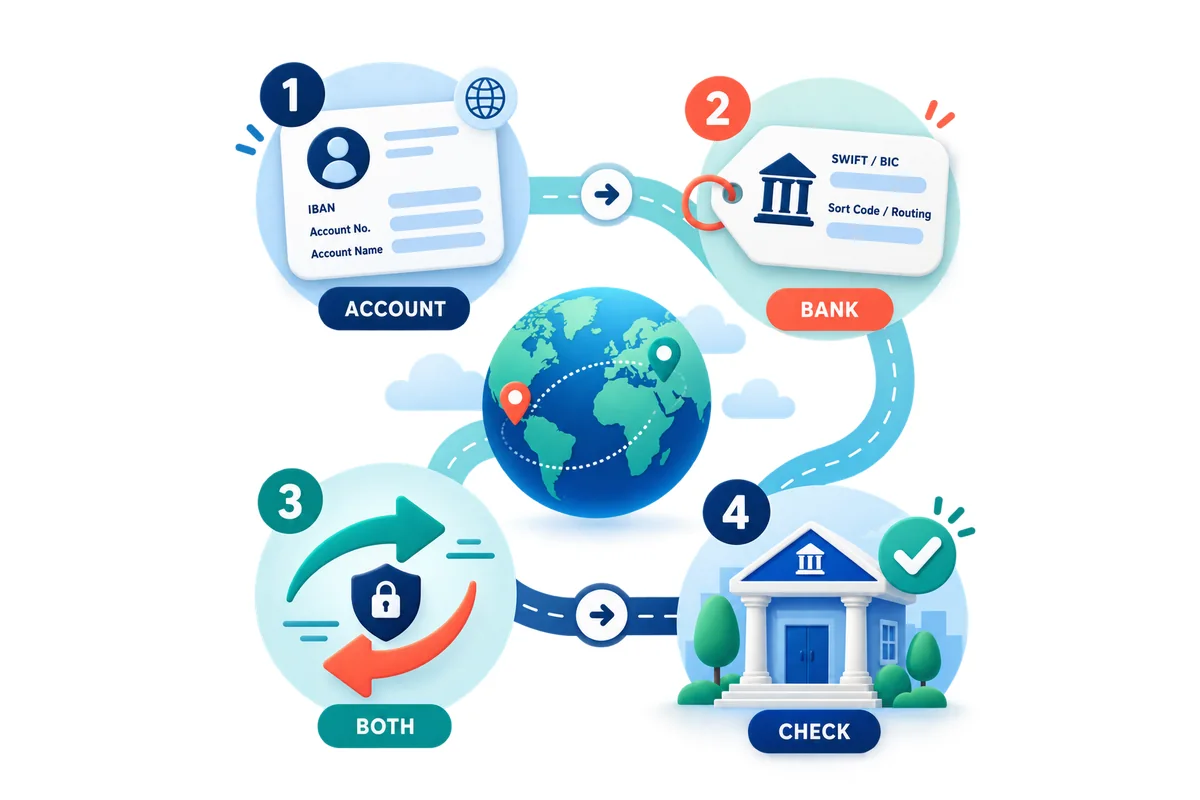
- Match the accountConfirm the IBAN belongs to the intended beneficiary and matches the bank-issued document or authenticated account view.
- Match the institutionConfirm the SWIFT/BIC is the one supplied for that bank, branch, currency, and payment route.
- Check the required combinationFollow the receiving bank's form instructions; do not add a second identifier merely because you have one available.
- Review before sendingVerify the name, currency, amount, purpose, and destination on the bank's final review screen.
Common IBAN and SWIFT mistakes
The most common mistake is treating two identifiers as if they were two versions of the same number. Another is copying a BIC from an old invoice or using a local sort code when a form explicitly asks for SWIFT/BIC. Formatting can also cause trouble: an IBAN printed with spaces may need to be entered without them, while a BIC must be copied with the exact letters and digits supplied by the institution.
A checker or decoder is useful for inspecting the characters you already have. It should not become a reason to guess missing bank data. If a real payment instruction is unclear, the safest next step is to ask the bank or the recipient, not to combine search results until a code looks plausible.
- Pasting an IBAN into a SWIFT/BIC field or a BIC into an IBAN field.
- Using a local account number as if it were a complete IBAN.
- Assuming a mathematically valid IBAN proves account ownership or payment reachability.
- Copying a BIC from an old document without confirming the current route.
- Mixing details from different beneficiaries, branches, currencies, or payment instructions.
IBAN vs SWIFT/BIC FAQ
What is the difference between IBAN and SWIFT?
An IBAN identifies a particular bank account within a country format. SWIFT/BIC identifies a bank or financial institution for routing. They serve different levels of the payment instruction.
Do I need both an IBAN and a SWIFT/BIC code?
Sometimes. The required fields depend on the banks, country, currency, and payment rail. Follow the receiving bank or payment provider's exact instructions instead of adding or omitting a code by assumption.
Can I find a SWIFT code from an IBAN?
Not reliably. An IBAN may show the country format and account structure, but the correct BIC can depend on the institution, branch, currency, and route. Confirm it with the bank or provider.
Can a SWIFT code be used as an IBAN?
No. A SWIFT/BIC identifies an institution and does not contain the customer's complete account identifier. Request the IBAN from the account-holding bank.
Is BIC the same as SWIFT code?
In everyday payment forms, SWIFT code and BIC often refer to the same institution identifier. Use the exact label and value supplied by the bank because route-specific instructions can still vary.
Does a valid IBAN prove that a bank account exists?
No. A format and MOD-97 check only test characters and mathematical consistency. They do not confirm account existence, ownership, status, sanctions screening, or payment success.
Is IBAN the same as SWIFT or BIC?
No. IBAN is account-level identification; SWIFT/BIC is institution-level routing identification. They can appear together but are not interchangeable.
What should I do if a payment form asks for a code I do not have?
Ask the receiving bank or payment provider for the exact code and whether it must be paired with the IBAN. Do not infer it from a name, card, or partial account number.
Bottom line
IBAN vs SWIFT is an account-versus-institution distinction. Use the IBAN for the particular receiving account and SWIFT/BIC for the bank or institution route when the payment instructions require it. Neither identifier should be invented or substituted for the other.
For a real transfer, use current bank-issued details and confirm the exact fields with the receiving bank or payment provider. For development and QA, the site's checker, decoder, and synthetic test data tools can help inspect format without turning generated values into payment instructions.
Official format references
- Swift IBAN Registry — Current country-level IBAN format registration and reference information.
- ISO 13616-1 — International standard describing the structure and processing of IBANs.